SSENSE AI models? Our QA rejected all 4 photos of the RCOS puffer
Published November 24, 2026. Press facts read on November 24, 2026.
Does SSENSE use AI models?
SSENSE has not said. On November 17, 2026, the designer Reese Cooper posted Instagram stories that showed errors in SSENSE’s photos of his RCOS clothes and called them AI-made. [1][3] In July 2026, the Montreal Gazette asked SSENSE whether layoffs in its photo team were due to AI. SSENSE did not confirm or deny it, and said it is “evolving our studio operating model to increase agility, accelerate content production”. [5][2] We ran the photos that Cooper called AI-made through Uwear’s AI QA, against the brand’s own product photos. It rejected all 4 SSENSE photos of his puffer jacket. It also missed a changed leg shape on another brand’s trousers, and it rejected some real brand photos. The details are below.
Disclosure. We make Uwear, an AI product photo platform with its own AI QA. The press facts come from the articles in the sources, read on November 24, 2026. The test results are our own.
What happened with the SSENSE photos that Cooper called AI-made?
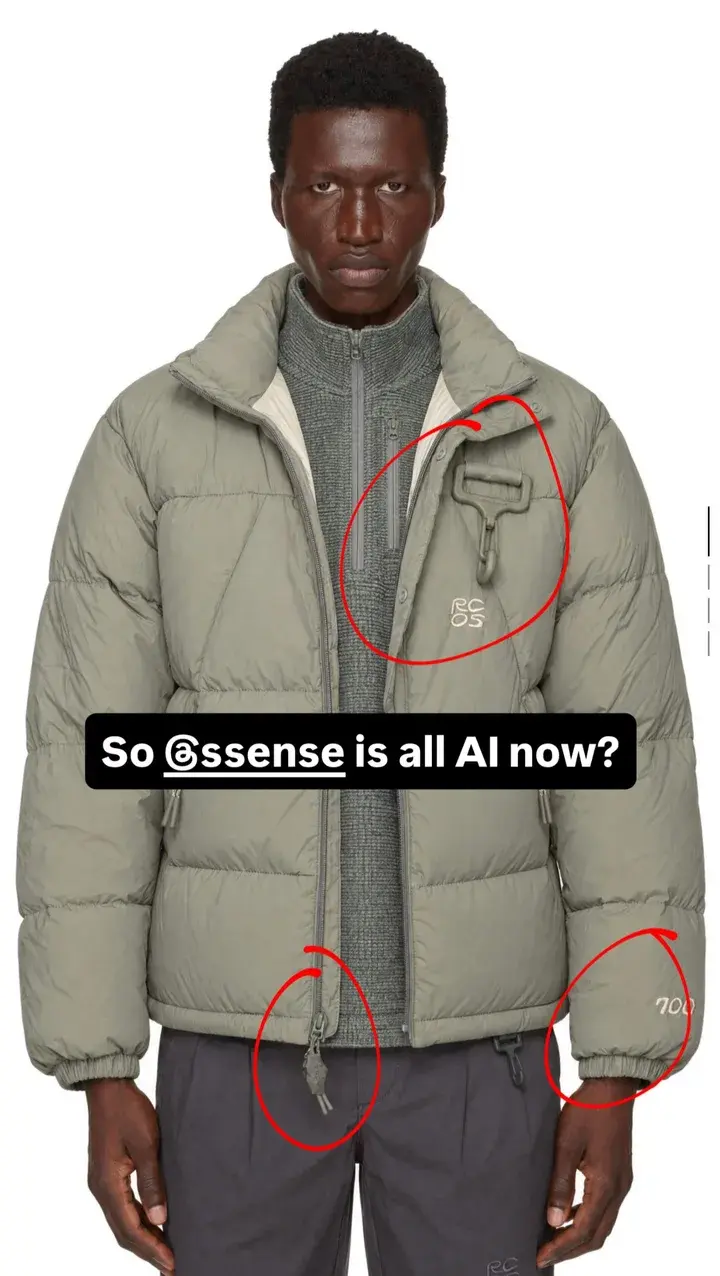
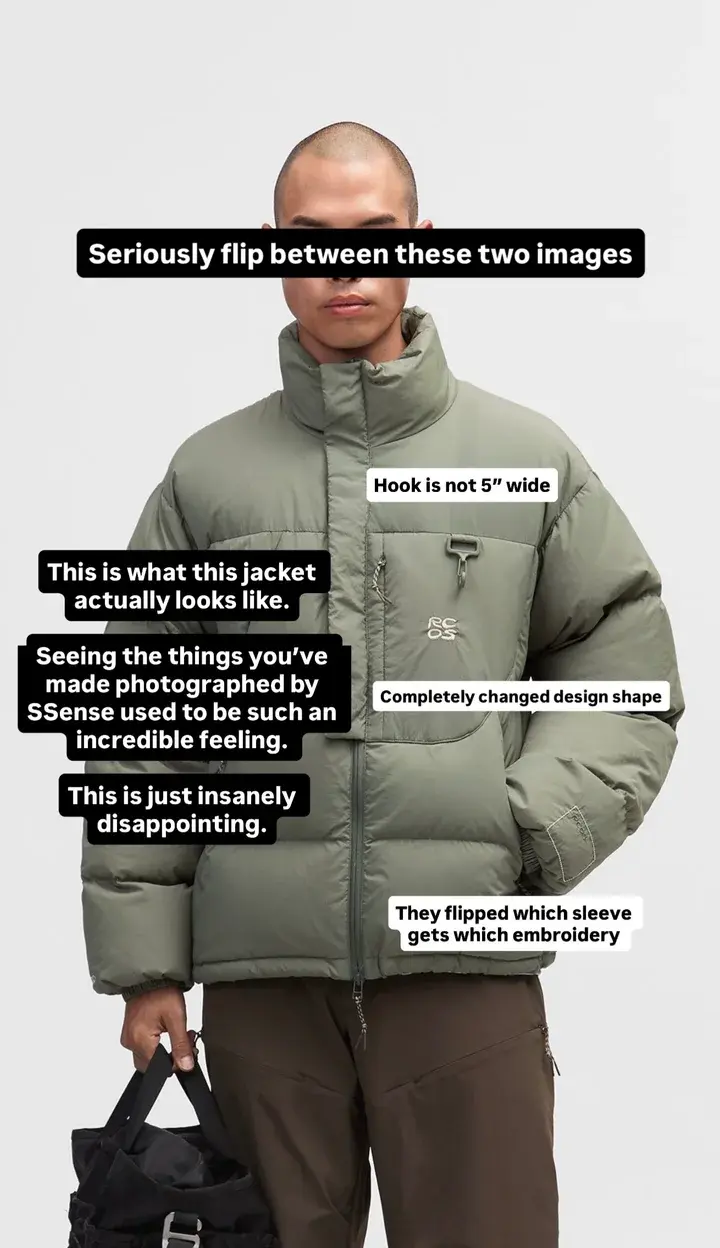
On Tuesday, November 17, 2026, Reese Cooper, the designer behind RCOS (RC Outdoor Supply), posted a series of Instagram stories about SSENSE’s product photos of his clothes. [1][4][6] On one story, he circled the chest, the zipper and a cuff of his Sierra Puffer Jacket on SSENSE’s photo and wrote “So @ssense is all AI now?”. On the next, he showed the real jacket with three notes: [3]
- “Hook is not 5” wide”. The hook on the chest is far too big on SSENSE’s photo.
- “They flipped which sleeve gets which embroidery”. SSENSE’s photo shows a “700” on the cuff where the real jacket has its boxed patch.
- “Completely changed design shape”. The chest panel and its lines do not match the real jacket.
He also wrote: “Seeing the things you’ve made photographed by SSense used to be such an incredible feeling. This is just insanely disappointing.” [1][4] And: “When someone gets their order and it doesn’t look like this, they aren’t upset with SSense they’re mad at the brand.” [1]
Other brands posted the same kind of errors. The FADER reports that SSENSE’s photos of Gerrit Jacob’s printed leather trousers showed “several hallucinated seams added at random” and a smeared print. [2] Thread Space published Sage Nation’s own comparison of its trousers. [3] Complex, MR Magazine, The FADER and Thread Space covered the story from November 18 to 20. [1][4][2][3]
Cooper’s stories have expired, and he has no post about them. These are the two stories, as Thread Space published them.
Would an AI QA check have caught SSENSE’s photos?
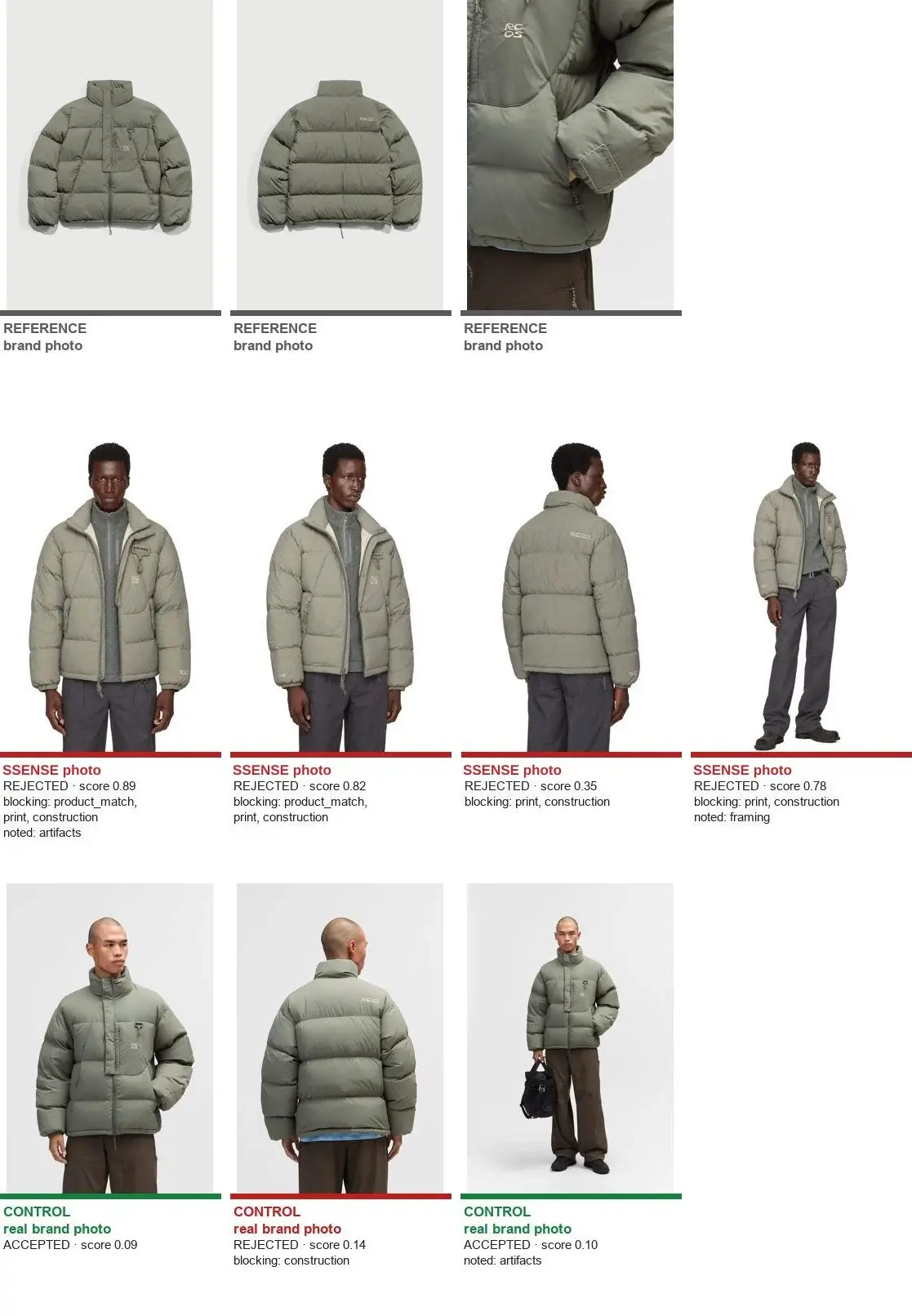
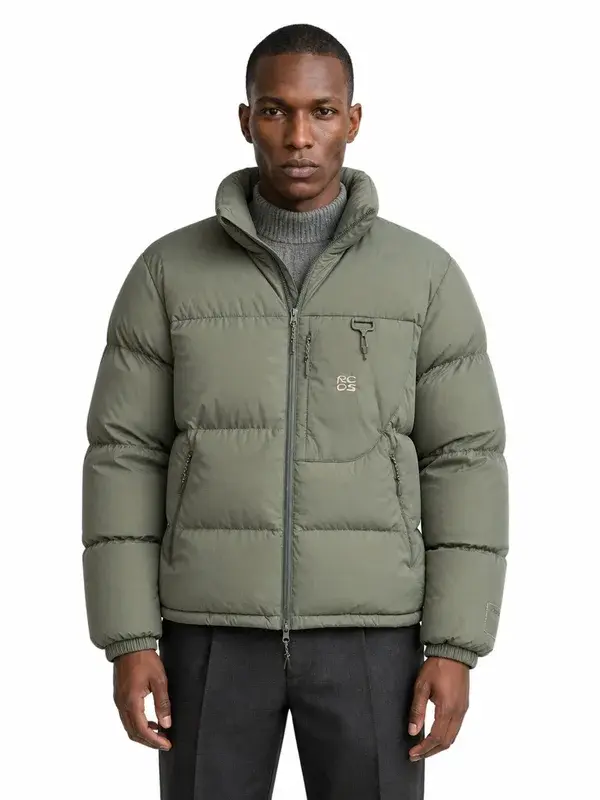
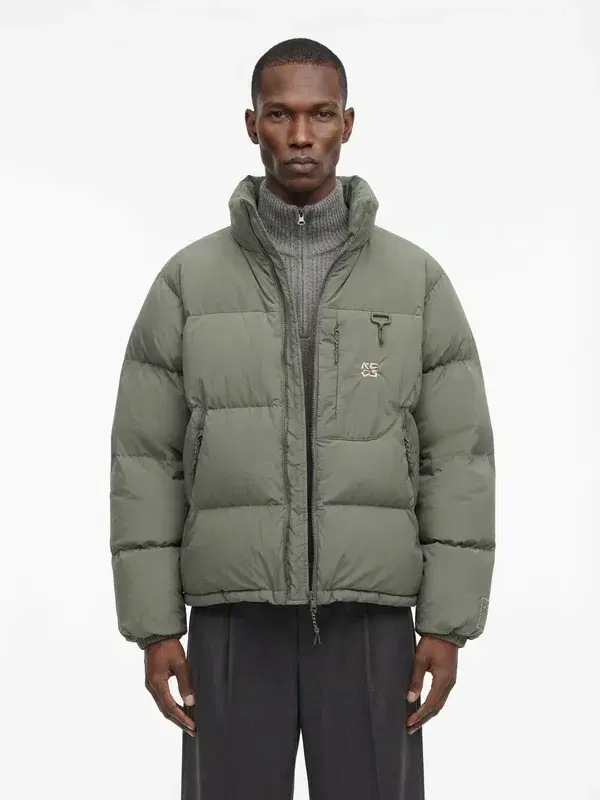
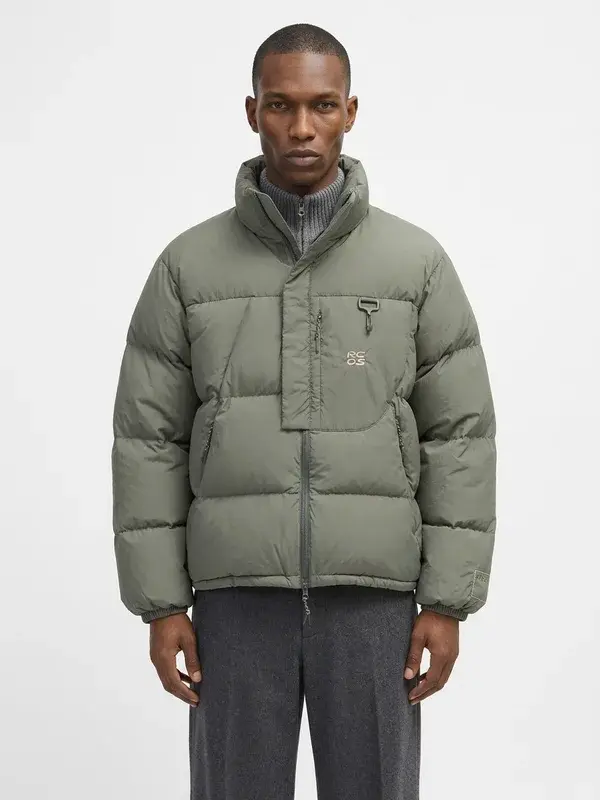
For the puffer, yes. On November 21, 2026, we ran SSENSE’s photos through the same AI QA that checks every Uwear photo. The only reference was the brand’s own 3 product photos of the jacket: the front, the back and a chest detail. We gave no text description of the details, which makes the check harder than on a normal Uwear photo. As a control, we ran 3 real RCOS photos of the same jacket, on a model, through the same check.
- All 4 SSENSE photos of the puffer were rejected. Their reject risk, the probability that a customer rejects the photo, was 89%, 82%, 78% and 35%. Our QA learned that risk from Uwear photos, not from SSENSE’s, so read the numbers as a direction.
- The real brand photos scored 9%, 14% and 10%. Two were accepted. The third was rejected on the construction check, which is the weak spot described in the next section.
- The failed checks match the kind of errors Cooper wrote about. On SSENSE’s front photo, the check failed on the print, the construction and the product match. Its reasons are general: “The print or decoration differs from the product.” and “A detail such as the neckline, sleeves, closures, pockets or trims differs from the product.” They do not name the hook or the cuff; Cooper’s notes and the photos do.
- A blocking check rejects a photo whatever its score. The SSENSE photo at 35% was rejected because the print and construction checks failed on it.
What did our AI QA miss?
We tested 4 more garments from the same story, one of them in two colours. We matched SSENSE’s photos of the RCOS shirt and the Sage Nation trouser to the brand’s products by eye. The results were less clean, and they show where an AI check is weak:
- A changed leg shape. On Sage Nation’s Welt Trouser, SSENSE’s photos show a straight, cropped leg. The real trouser has a rounded barrel leg. Our check did not fail the length or the product match on any of the 8 SSENSE photos of the trouser, in two colours. Flat product photos do not show how a leg falls on a body, and the brand’s on-model photo as a second reference did not help it catch the leg shape.
- Too strict on real photos. The check rejected 6 of the 13 real brand photos we used as controls: 5 on the construction check alone, and 1 on length. On a real photo, another model or another pose can hide a pocket or fold a closure, and the check reads that as a change. On the RCOS shirt and fleece, it rejected every SSENSE photo but also 4 of the 6 real photos, so we do not count those as catches.
- A weak reference. It rejected all 4 SSENSE photos of Gerrit Jacob’s trousers, but our only real photo of them was one lookbook image in a lighter colour. Part of that rejection can come from the reference.
Both weak spots, leg shape and the strict construction check, are on our QA team’s list. A check that is too strict costs a retry; a check that misses an error lets a wrong photo through. That is why people still review what the check flags, and a sample of what it passes.
If AI made these photos, why would a current model make these errors?
Reda Mjahed, Uwear’s CEO, does not think a current image model makes errors like these when it gets the right product photos. His view: either an older model was used, or the model got the wrong context, such as the wrong reference photos or the wrong product. SSENSE has not said which tool or model it uses, so this is his opinion, not a fact about SSENSE.
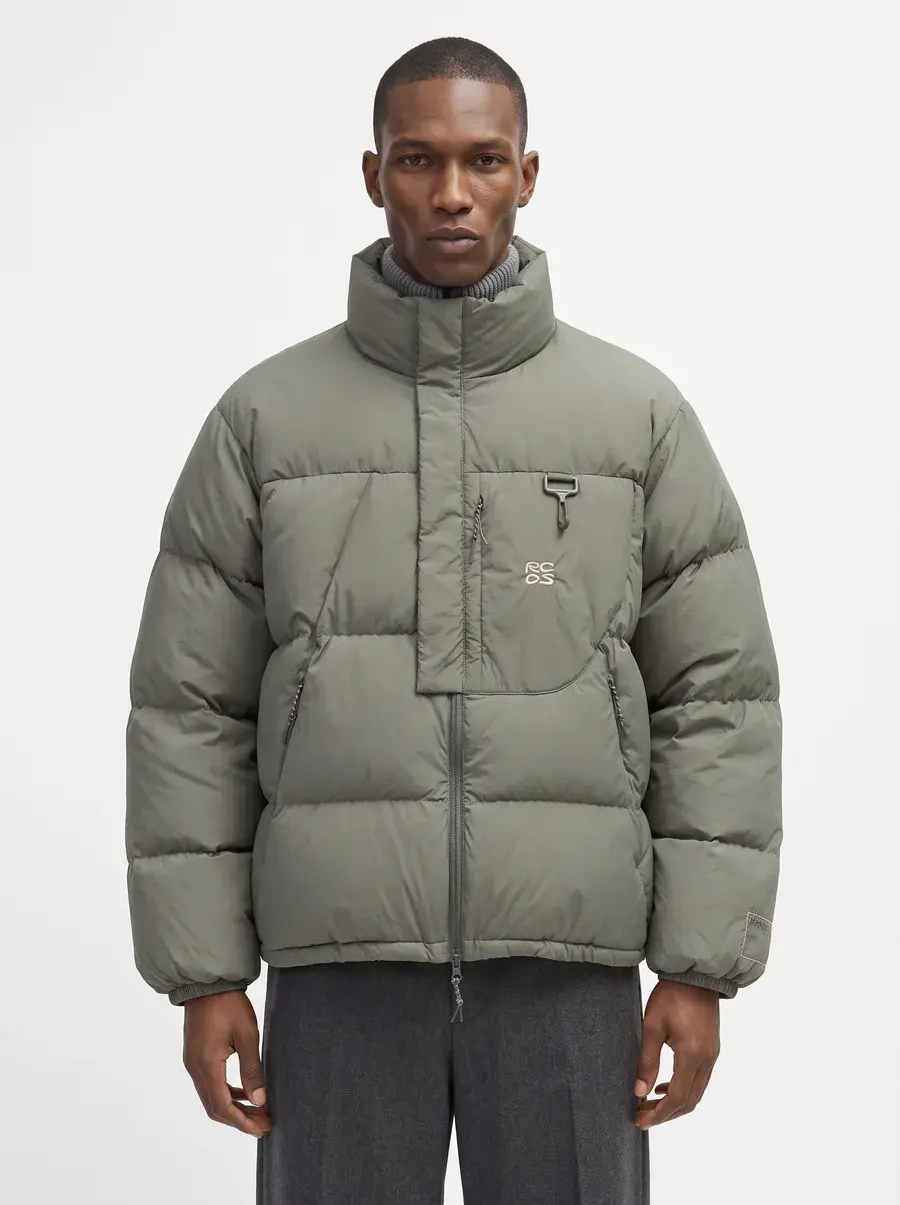
We tested the first half on Uwear on November 21, 2026: the same jacket, the same 3 brand photos, the same model and art direction, one front shot. On 3 older or cheaper models that Uwear offers, Gemini Flash, Gemini Flash 2 Lite and GPT Image 2 (low), 4 of 6 first tries got the front closure wrong: the storm flap over the zipper disappeared or changed. On Gemini 2.1, the storm flap was there on every front photo, including the photo at the top of this page. Our QA rejected all 4 wrong photos. On 3 of them, it also said why in plain words, for example: “The storm flap over the front zipper present in the reference is missing, leaving the zipper exposed.”
It is a small test: 2 photos per model, one angle. It shows a direction, not a rate. No older model made SSENSE’s exact errors, such as the oversized hook or the “700” cuff. They made errors of the same kind: a closure or a trim that changed. The check also rejected one correct Gemini 2.1 photo, on the strict construction check from the previous section.
Human QA or AI QA: which works at catalog scale?
After the story, much of the debate became “keep a human in the loop, or use no AI images”. Reda’s argument is that a human check alone does not hold at a retailer’s scale, with a whole season of products and several photos for each. A person does not look at the 3,000th sleeve with the same eyes as the first, and cannot say afterwards which photos they missed.
An AI reviewer compares every photo with the brand’s own product photos, the last one like the first. When it is wrong, it is wrong in a repeatable way: our tests show that it is too strict on full-body side shots and weak on leg shape. Because its mistakes repeat, they can be measured and fixed.
So the person does not go away. They stop checking every photo and review the photos that the reviewer flags, plus a sample of the photos it passed. For the full method and a checklist, read how to check AI product photos for mistakes at scale. [8]
How does the Uwear AI QA work now?
- It runs free on every image. Each photo you generate or edit on Uwear gets an AI check against its inputs: every garment against its own product photos, the person against your saved model, and the shot against the prompt. [7]
- You pick what the verdict does. By default it only flags: the verdict and its reason show on the photo. Turn on Auto QA or automatic retries, and the verdict approves or rejects the photo. With automatic retries on, a rejected photo is shot again with the same request. A retry costs the same as a new photo. [7]
- You can change a verdict. Approve or reject any photo yourself in Studio. Your decision is recorded on the photo. [7]
- We tune it on those decisions. Behind the check is a GPT decision model from OpenAI. We fit it on the approve and reject decisions of Uwear users, so it learns what brands reject.
- Run it from your assistant, the API or Studio. Connect the Uwear MCP server to ChatGPT, Claude or Codex and ask it to shoot your products with QA on and read the verdicts. The API sets QA and retries on each request. In Studio, you switch it on for a run. [9][7]
What else should I know about the SSENSE photo case?
Did SSENSE use AI for its product photos?
SSENSE has not confirmed it. Reese Cooper, Gerrit Jacob and Sage Nation posted SSENSE photos of their clothes with errors, and Cooper called the photos AI-made. In July 2026, the Montreal Gazette asked SSENSE whether layoffs in its photo team were due to AI. SSENSE did not confirm or deny it, and said it is evolving its studio operating model to increase agility and accelerate content production.
What was wrong with SSENSE’s photo of the RCOS puffer?
In Reese Cooper’s stories, the chest hook is far too big, the embroideries are on the wrong sleeves, and the shape of the chest panel changed. A cuff on SSENSE’s photo shows a “700” where the real jacket has a boxed patch.
Can an AI QA check catch errors like these?
It can, when it compares each photo with the brand’s own product photos. In our test, Uwear’s AI QA rejected all 4 SSENSE photos of the RCOS puffer and accepted 2 of 3 real brand photos of the same jacket. It missed a changed leg shape on a pair of trousers, so people should still review the flagged photos and a sample of the passes.
Is the Uwear AI QA free?
Yes. The check runs free on every image you generate or edit on Uwear. By default it flags; with automatic retries or Auto QA on, it approves or rejects. A retry of a rejected photo costs the same as a new photo.
How Uwear review and retries workWhich AI model does Uwear use to check photos?
A GPT decision model from OpenAI, tuned on the approve and reject decisions of Uwear users. It gives each photo a reject risk and a reason for each failed check.
Sources
We make Uwear. The press facts come from the articles below, read on November 24, 2026. The test results come from our own runs on November 21, 2026, described above.
- [1] Complex: Reese Cooper calls out SSENSE’s AI product images (November 18, 2026). Accessed November 24, 2026.
- [2] The FADER: the SSENSE AI product photos, explained (November 19, 2026). Accessed November 24, 2026.
- [3] Thread Space: The SSENSE AI product pics fiasco (November 20, 2026). Accessed November 24, 2026.
- [4] MR Magazine: Reese Cooper calls out SSENSE over alleged AI-generated images of his designs (November 18, 2026). Accessed November 24, 2026.
- [5] Montreal Gazette: Ssense lays off most of visuals department to replace with AI, former photographer alleges (July 4, 2026). Accessed November 24, 2026.
- [6] RC Outdoor Supply (RCOS), the brand’s own store. Accessed November 24, 2026.
- [7] Uwear Review & QA: what the AI reviewer checks and how retries work. Accessed November 24, 2026.
- [8] Uwear: how to check AI product photos for mistakes at scale. Accessed November 24, 2026.
- [9] Uwear MCP server. Accessed November 24, 2026.
Last updated November 24, 2026.